Email email Print print

Offshore operators’ needs met by innovations and upgrades
30 Nov 2011
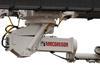
Chain wheel manipulator developed by Cargotec

Chain wheel manipulator developed by Cargotec

Cargo handling group Cargotec says its understanding of offshore support operations enables introduction of innovative solutions, developed in-house or requested by customers, encompassing upgrades as well as new systems.

As an example, STX approached Cargotec recently for a solution that would allow chain wheels to be changed at sea in order to handle a variety of chain sizes used by subsea mooring equipment. This was needed for five STX OSV design AHTS vessels being built at STX Offshore Brazil for DOF. These vessels will be working some distance off the Brazilian coast under long-term contracts from Petrobras, which specified that it should be possible to change chain wheels at sea.

“Otherwise, it would take about a day for an AHTS to return to port each time it needed to change a chain wheel, and another day to get back to operation area, which is obviously inefficient for the operator,” Jon Helle, sales director, advanced load handling at Cargotec says. “Consequently, our engineers devised the MacGregor chain wheel manipulator.”

The device is remotely controlled by a crew member from a portable panel. The manipulator unit is suspended from two overhead-mounted beams in a vessel’s winch hangar. A hydraulic clamp system keeps it secured to the beams at all times, even when moving a load.

“This equipment removes a chain wheel from the winch shaft in a safe and controlled manner, even when the vessel is at sea,” Helle says. “It then takes the wheel to the storage area without manual intervention. The system is designed in accordance with DNV rules for certification of lifting appliances and can accommodate chain wheels of various sizes, covering all anchor handling demands likely to be made of any AHTS. We also have several other contracts for the chain wheel manipulator, “the first of which will be delivered to Siem Offshore for its AHTS Siem Ruby”.

Another recent new product development, which stemmed directly from a customer request, is a novel type of launch-and-recovery system (LARS) for an ocean-bottom seismometer system developed by CGGVeritas. The new LARS handles the system’s autonomous Trilobit seismometer nodes, which are supported by a ‘basket’ holding the seabed units. These nodes provide high quality data in marine exploration and production areas that are inaccessible to traditional towed-streamer and ocean-bottom cable acquisition systems.

Maintaining peak performance

Cargotec says that as well as new products, key existing offshore equipment can benefit from the company’s continuous product development strategy to advance safety and operational standards. “Modernising shipboard equipment to take advantage of technological developments makes sure that it stays as safe and effective as possible throughout the ship’s lifetime,” says Helle. “That doesn’t mean that equipment is inevitably getting more and more complex. New technology can often make it possible to simplify a system, and make it more reliable, which is a valued characteristic offshore.”

Cargotec is continuously developing modernisation options that can be retrofitted to its MacGregor offshore load-handling equipment. Examples of this are:

  • The remotely-operated deck handling manipulator system, designed to improve safety and operability on the aft deck by providing articulated chain and wire gripper functions. Heavy loads can be held and moved to working positions without the need for re-rigging between gripper and winch operations.
  • The ultra-deepwater lifting system can be used – without modification – in conjunction with any active heave-compensated subsea crane, enabling it to handle heavier loads at much greater depths. While the weight of a crane’s steel wire applies load penalties as depth increases, using the UDLS’s neutral buoyancy fibre rope system eliminates the wire weight penalty for the vast majority of the depth so that the existing offshore crane can operate to its full load capacity at previously impossible depths, keeping the load safely under control. Full video monitoring of the UDLS crane/vessel hand-over system along with anti-twist control provides the safest way to handle ultra-deep heavy loads, and there is no need for an ROV.
  • ‘Float the load’ automatically maintains a set distance between the load and the deck or seabed by adjusting the winch position when the crane’s boom angle changes.
  • Running-hour counters help monitor the wear rate of different moving parts, such as gears, bearings and motors and assist in maintenance procedures.
  • A new auto hook correction function automatically controls the winch to keep the distance between the boom-tip and hook close to constant
  • Operators can set crane speed limitations for different functions, by moving sliders to a percentage of maximum speed
  • Cranes can be equipped with a set-up for full scale calibration of load cells.
  • Crane cabin innovation options include two new, large multi-function joysticks with a Profibus connection to the onboard control system or PLC; a modified window safety grill to improve the view; high-quality sunshade foils; a Recaro operator seat; and a second operator panel to reduce screen switching, increase monitoring ability and/or display the crane load calculator in real time running mode.
  • A range of general conversions and modernisations can improve a crane’s hydraulic and control systems, and provide a larger crane radius, higher lifting capacity and/or more wire capacity. Standard safety upgrades include equipping winches with a personnel lift, and automatic and manual overload protection systems.
  • An Arctic package introduces components and designs specifically aimed at ensuring the safe, reliable functioning of equipment and more comfortable working conditions for personnel in heavy-ice environments with extremely low temperatures.
  • Winch advances include the option to simultaneously operate two winches and the ability to convert different winches to include active heave-compensation and auto tension modes. An intelligent wire lifecycle calculator is a predictive tool that uses historical commercial data, to display the expected remaining and accumulated bend cycles for the steel wire.

Images for this article - click to enlarge

Chain wheel manipulator developed by Cargotec

Unless otherwise stated, all images copyright © Mercator Media 2013. This does not exclude the owner's assertion of copyright over the material.


Job Opportunities