


IMO Type Approval issued for Ecochlor’s filterless BWMS solutions
The Norwegian Maritime Authority has issued a Type Approval for Ecochlor’s EcoOne™ BWMS and EcoOne Hybrid™ BWMS solutions. The certification is an amendment to Ecochlor’s existing BWMS Type Approval, and certifies the systems meet the more stringent revised standards set by the BWMS Code.
Ecochlor remains on track to obtain USCG Type Approval by the end of 2021.
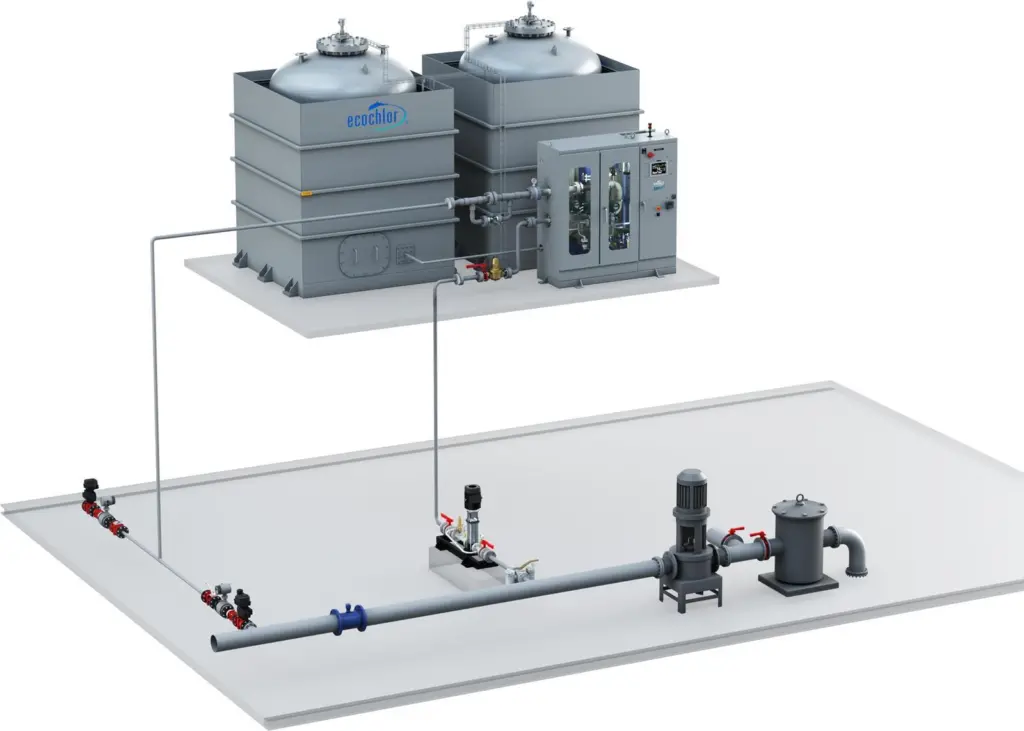
The EcoOne™ BWMS works as a single-step system using chlorine dioxide (ClO2) treatment technology, without a filter and in all operating conditions in brackish and marine waters. DNV was the independent laboratory (IL) during the certification process, and took overall responsibility for the entire process of evaluation, inspection, testing and submission of all type approval applications for the system.
Land-based biological efficacy tests were undertaken by the Golden Bear Research Center (GBRC) in California, USA. The Shipboard tests, undertaken by DHI as sub-laboratory, were completed to test the biological efficacy and related shipboard operational performance of the EcoOne™ BWMS on board commercial vessels. This testing was performed on two vessels owned by Maran Tankers, a VLCC and an Aframax, during their typical voyages.
Pete Thompson, VP of Operations, who spearheaded the R&D of the EcoOne™ BWMS and EcoOne Hybrid™ BWMS noted, “our team is very excited to bring these new and innovative BWMSs to market. We have worked diligently over the last 18 months along with DNV, Maran Tankers, Golden Bear and DHI to test the EcoOne™ BWMS and EcoOne Hybrid™ BWMS to the highest standards possible in compliance with IMO testing requirements and to ensure the operational reliability that is expected from every single Ecochlor system.”
The ClO2 technology is well-suited for use in a filterless BWMS option: “ClO2 technology is not affected by suspended sediments or turbidity. Therefore, filtration is not necessary to remove sediments prior to treatment, unlike UV technology. Additionally, ClO2 technology primarily reacts with living organisms (rather than reacting with all organic matter) and does not require significantly increasing the dose to effectively treat the ballast water.
On the other hand, sodium hypochlorite or electro-chlorination-based technologies react with any organic matter living or dead and require a very large increase to the chemical dose to ensure treatment efficacy. This increased dosage requires additional power to produce the higher levels of hypochlorite and therefore, could potentially be hazardous to tank coatings and vessel structures.”
Related Articles
 EQUIPMENT
 EQUIPMENT
 EQUIPMENT