
Land-based testing for the hydrogen-fuelled engine completed
Japan Engine Corporation, Kawasaki Heavy Industries and Yanmar Power Solutions have completed land-based testing of the 6UEC35LSGH, a high-pressure direct-injection hydrogen-fuelled engine developed for large commercial vessels.
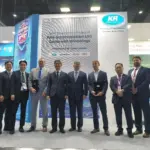
The engine was unveiled to project stakeholders on September 7th, and approval testing completed in the presence of classification society Nippon Kaiji Kyokai (ClassNK).
According to the companies, the 6UEC35LSGH achieved a hydrogen co-firing rate of at least 95% during land-based factory testing, alongside a reduction in greenhouse gas emissions of more than 95% compared with typical heavy-fuel-oil engines.
The work is being developed under the New Energy and Industrial Development Organisation’s (NEDO) Green Innovation Fund Project and the “Blue Harmony” imitative. It aims to support the commercialisation of hydrogen-fuelled vessels.
6UEC35LSGH is based on a high-pressure direct-injection combustion system designed to enable hydrogen to be used as the primary fuel in large marine vessels. The design is focused on incorporating safety measures to prevent hydrogen leakage, including double-walled piping for hydrogen supply lines.
Next steps
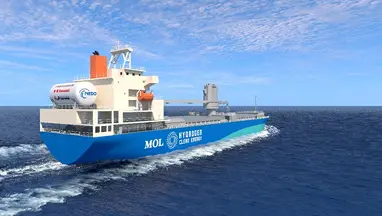
The next stage of the programme will see the engine installed aboard a 17,500 DWT multipurpose vessel, currently being built by Onomichi Dockyard for Mitsui O.S.K. Lines (MOL) and MOL Drybulk.
Installation is scheduled for January 2027, with sea trials and onboard demonstration testing planned to begin in April 2028. The demonstration will allow the project partners to evaluate the engine under operational conditions, providing data on performance and durability.
Kawasaki Heavy Industries will supply the Marine Hydrogen Fuel System (MHFS), including liquefied hydrogen tanks. The company is also developing bunkering equipment for liquefied hydrogen to support the vessel demonstration.
The 2028 demonstration will provide an opportunity to evaluate the developing technology beyond the factory environment, assessing the durability of hydrogen-fuelled marine propulsion.
Related Articles
 INTERVIEWS
 THRUSTERS & PROPULSORS