



Autonomous test vessel navigates obstacles
An autonomous ship model tested in Aker Arctic’s ice model test laboratory has demonstrated the ability to detect obstacles utilising onboard sensors, manoeuvre around them without operator input and moor itself automatically to a target pier.
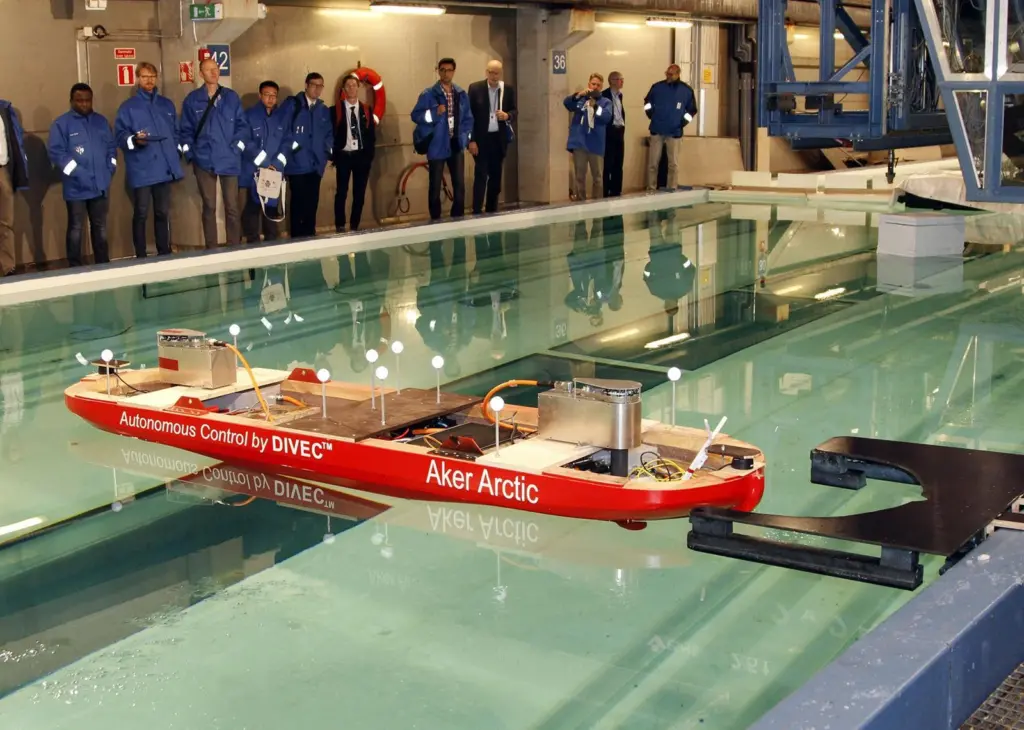
The wireless model used in the test, carried out in ice-free waters, is equipped with battery powered propulsion units, data transfer to the ‘shore facility’ and an autonomous navigation system that routes the vessel around obstacles detected by the onboard sensors.
Components are connected using Distributed Intelligent Vessel Components (DIVEC), a specially developed network framework that provides a modern protocol for connecting devices and transferring necessary data between them.
Aker Arctic’s ice laboratory in Helinksi is normally used to test icebreaking vessels but can also be used to develop and test the technology, sensors, algorithms and propulsion control systems being developed for autonomous vessels under harsh environmental conditions.
DIVEC provides an extensible and adaptable infrastructure that allows interfacing with third party systems and components. The technology used in the autonomous ship model tests in the laboratory is also adaptable to semi and full-scale prototypes.
Related Articles
 OTHER NEWS
 INDUSTRY NEWS
 ALTERNATIVE FUELS & LUBRICANTS