





ABS sets framework for safer industrial AR
ABS is urging marine and offshore operators to assess augmented reality’s productivity benefits against safety risks before deployment
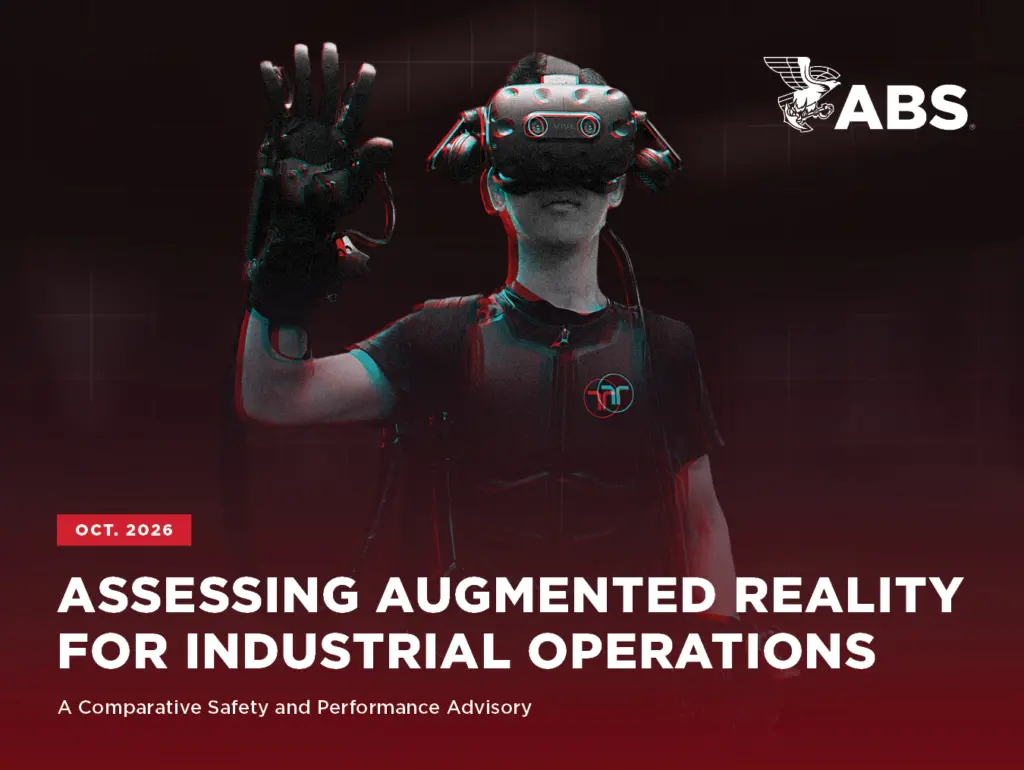
Augmented reality (AR) could improve productivity and consistency across marine and offshore operations, but operators must demonstrate that its benefits do not compromise safety, according to the American Bureau of Shipping (ABS).
The organisation’s latest publication, ‘Advisory on Assessing Augmented Reality for Industrial Operations’, provides a framework for evaluating the technology across inspection, maintenance, navigation, training and remote assistance, comparing AR-enabled activities with existing working practices.
“Augmented reality could change how industrial work is performed, bringing expert guidance, operational data and digital workflows directly into the user’s field of view,” said Patrick Ryan, ABS senior vice president and chief technology officer. “To unlock that potential responsibly, industry needs a clear understanding of the safety and performance implications.”
AR can display step-by-step instructions, highlight inspection points and equipment tolerances, and identify hazard zones directly within a worker’s field of view. These capabilities could help crews complete complex procedures more consistently, reduce reliance on memory and access specialist guidance without interrupting tasks.
However, ABS cautions that effectiveness depends on the task, the user and the operating environment. Information overlays may distract workers, obscure parts of their surroundings or encourage excessive reliance on digital instructions, potentially introducing new operational hazards.
Developed with support from the ABS Laboratory for Ocean Innovation at Texas A&M University, the advisory outlines a structured approach to measuring AR’s effects on safety and performance. It considers how different activities place demands on navigation, hand-eye coordination, memory and information processing, emphasising the need for task-specific assessments.
For marine and offshore operators, the guidance offers a way to determine where AR could deliver measurable operational improvements and where additional safeguards or alternative approaches may be necessary.
Related Articles
 MONITORING, CONTROL & DIGITALISATION
 MONITORING, CONTROL & DIGITALISATION
 MONITORING, CONTROL & DIGITALISATION