




Leonhardt expands its wind propulsion strategy
Leonhardt & Blumberg has equipped its first newbuild with Econowind VentoFoils to reduce fuel consumption and emissions through wind propulsion.
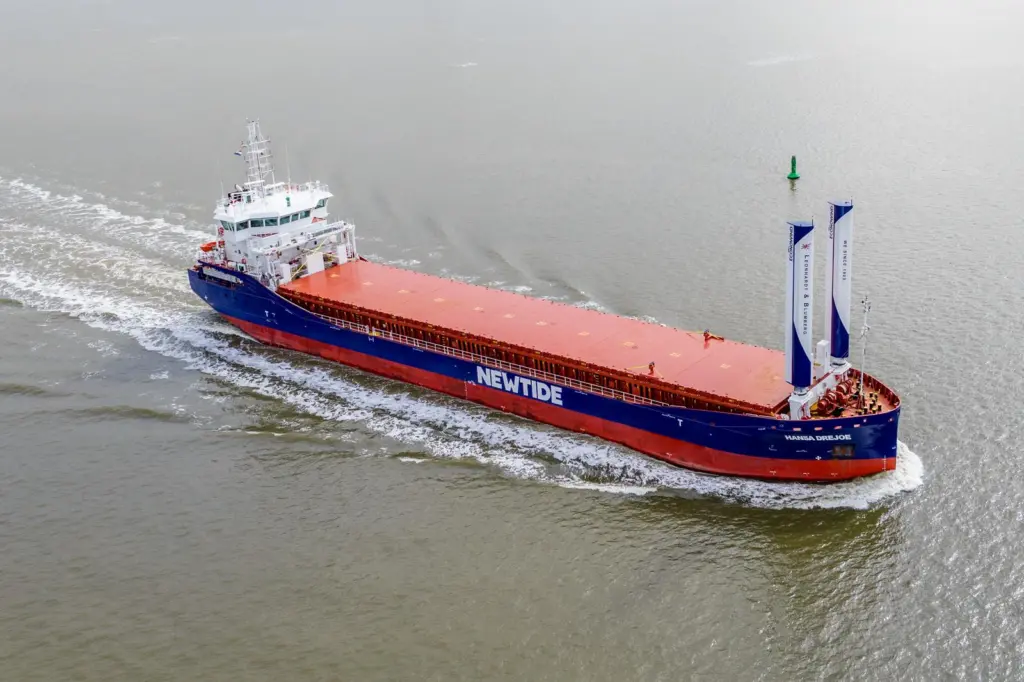
Hansa Drejoe received the technology at Royal Niestern Sander Shipyard in early August, becoming the first of four general cargo newbuilds to adopt wind-assisted ship propulsion as the owner gains operational experience.
“We see wind-assisted ship propulsion as a logical next step in our journey toward greener operations,” said Christoph Meier, naval architect at Leonhardt & Blumberg.
“Of course, the business case is important, but we also feel a responsibility to move the industry forward.”
Vessel efficiency
Econowind estimates the VentoFoils will provide around 10% additional thrust, reducing fuel consumption and CO₂ emissions accordingly.
The assessment is based on the vessels’ actual trading routes throughout the year, supporting the technology’s potential contribution to fuel efficiency and emissions reduction in commercial shipping.
Hansa Christiansoe is currently at Royal Niestern Sander Shipyard, while the two remaining vessels are under construction in China.
The four Groot XL-type vessels, designed by Groot Ship Design, were engineered for straightforward integration of wind propulsion technology.
The Chinese-built vessels are expected to arrive in Europe during the first half of 2027 for final outfitting and commissioning.
Leonhardt & Blumberg said the VentoFoil installations form part of a broader programme exploring complementary technologies capable of delivering measurable operational and environmental benefits.
Econowind’s compact, autonomous wing systems can be tilted within seconds and use boundary layer suction to generate additional thrust and optimise aerodynamic efficiency.
The technology has already been deployed across general cargo, tanker, heavy-lift and multipurpose vessels.
Related Articles
 ELECTRIFICATION AND BATTERY HYBRIDS
 TURBOCHARGER
 INDUSTRY NEWS