


Everllence and Hudong advance LNG propulsion
Everllence has signed an Engineering Design Agreement with Hudong-Zhonghua Shipbuilding to develop a 180,000-cubic-metre-class LNG carrier featuring an Everllence DFE+ dual-fuel electric propulsion system.
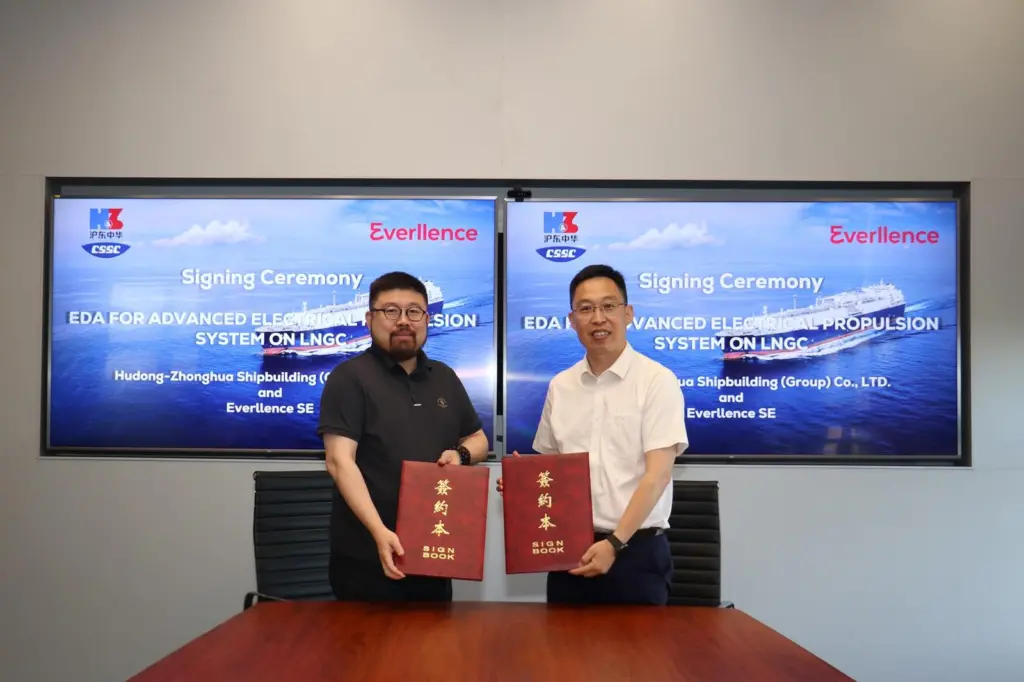
The agreement strengthens an existing relationship between the companies, which have previously collaborated on the delivery of 10 conventional dual-fuel diesel-electric LNG carriers.
“Decarbonisation is an obvious development trend in the shipping industry,” said Song Wei, chief technical engineer of Hudong-Zhonghua.
“We are very glad to work together with Everllence to develop the hybrid-electric propulsion solution with high efficiency on LNG carriers, which shall provide more options for ship owners.”
The EDA was signed on 5 June by Yang Chunhua, technical centre deputy director at Hudong-Zhonghua, and Pan Ke, head of sales and projects, Four-Stroke China, representing Everllence.
The proposed vessel will use Everllence’s DFE+ propulsion technology, combining dual-fuel engines with an electric architecture designed to improve operational flexibility and efficiency. The companies said the development could support more environmentally friendly LNG transportation as shipowners work towards the industry’s target of achieving net-zero greenhouse gas emissions by 2050.
The collaboration brings together Hudong-Zhonghua’s experience in LNG carrier construction and Everllence’s expertise in four-stroke engine technology.
“Nowadays, individual technology providers can only achieve marginal efficiency improvements,” said Dominik Thoma, global manager LNG Cargo at Everllence. “Accordingly, for bigger gains, shipyards and engine manufacturers need to work closely together.”
Thoma said the companies’ combined capabilities could help advance propulsion system performance for LNG carriers. The project reflects a wider industry shift towards integrated technologies capable of delivering efficiency improvements while meeting tightening environmental regulations.
The development could also give LNG carrier owners greater propulsion options as regulatory pressure increases and operators seek to reduce fuel consumption, emissions and lifecycle costs across their fleets.
Related Articles
 BATTERY HYBRIDS & FULL-ELECTRIC VESSELS
 BATTERY HYBRIDS & FULL-ELECTRIC VESSELS
 BATTERY HYBRIDS & FULL-ELECTRIC VESSELS