

The Motorship meets Auramarine’s CEO John Bergman
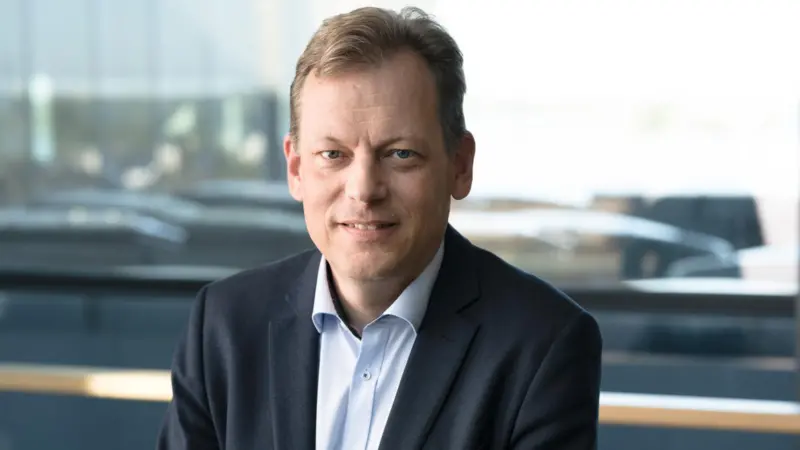
Auramarine celebrated its 50th anniversary this month, the same month it launched its ammonia fuel supply system (FSS). We spoke to the company’s CEO John Bergman (pictured) about both milestones.

“You can see that everything revolves around this green transition and I strongly believe we’re going to be there in it, making sure that the marine industry is able to complete this transition,” says Bergman when asked about where Auramarine is heading in the future.
Bergman has extensive experience leading multinational companies having previously held C-suite roles at material handling systems company Raumaster and Voith Paper Group before taking the helm at Auramarine in 2020. His experience of living in China and the Asian markets in these roles are boons for Auramarine, with the company having a presence in Shanghai. Bergman quickly dismisses the idea that a factory in China, which Auramarine has, is simply a way to enjoy cheaper labour costs as he identifies the growing middle class in the country, likening the work force to “white collar” workers.
Given the growing dominance of China in the maritime sector, Bergman’s experience of how to do business there is key. “If you want to do business in China, you need to be 100% committed to the Chinese market and to working there with the local customers, the local suppliers and with the local rules and regulations,” he says, adding that doing business half-heartedly is a surefire way to “lose money”.
He adds that the pace of the Chinese market is another aspect that should not be overlooked for companies looking to operate in the area. “There’s also a “China speed” over there, the clock speed of businesses and the society is higher so you need to be committed to working almost 24/7 over there. Things are happening all the time and you need to be completely on the pulse in China,” he says.
With Auramarine’s Shanghai operation opening last year and already capable of producing 500 of its methanol FSSs per annum, the company had a big announcement at the end of summer.
New ammonia fuel supply system
At this year’s SMM, Auramarine launched its ammonia FSS, hoping to repeat the success of its methanol FSS that was included on the first methanol ready cruise ship, the Mein Schiff, owned by Tui Cruises earlier this year.
When asked if ammonia will see widespread adoption as a maritime fuel, which the International Energy Agency says is vital if the sector to achieve its ambitious net zero targets, Bergman says: “Ammonia will be one of the major fuels in the shipping industry, but I don’t believe it will be alone out there.” He adds that other fuels including green methanol and similarly cleaner formulations of LNG will also be part of this multi fuel future.
One of the major concerns about the use of ammonia is its toxicity, although Auramarine’s system includes gas and leak detection, ammonia capture, reliquefying and ammonia release mitigation functions. “The [IMO] rules clearly state that you must have a safe haven for every person on board and it needs to be accessible in a certain time. That really limits how large a number of passengers or crew you can have aboard,” says Bergman regarding the regulatory framework within which Auramarine’s ammonia FSS was developed and its impact on suitable vessel types for the system.
The safety concerns of using ammonia as a marine fuel seem paramount to Bergman who says: “As ammonia is extremely toxic, and is gaseous in ambient conditions, there’s a lot of thought which has gone into safety, and that’s has been priority number one. Safety of people, safety of systems and also being mindful of Aquatic life.”
Bergman says its FSS can be used with both 2-stroke and 4-stoke engines and also gave some insight into its use in retrofitting vessels. “If you find the space onboard and if you’re able to make a safety arrangement so that you have enough space, then for sure it can be retrofitted. I would say on a pure HFO or a diesel vessel, it’s going to be much more challenging because there is simply not the space available,” he says.
He adds that for LNG powered vessels, there’s a possibility that some parts of the LNG system could be reused for Auramarine’s ammonia FSS. Bergman says that one example would be the tanks, if the nickel content of the metal which has been used is low enough then those parts could be possibly reused. “But the main thing is really the space needed,” he emphasises.
Auramarine’s ammonia FSS was developed in collaboration with experts on ammonia as well as using findings from the HENNES research project which Auramarine participates in. The HENNES project is based in Finland and studies the physics and chemistry of hydrogen combustion, including its derivative fuels such as ammonia.
The first Auramarine ammonia FSSs are set for delivery in 2026 and with clients for its methanol system including the likes of Terntank and Turkey’s Sanmar Shipyards, Bergman’s “ongoing discussions” with existing clients for its new system may prove interesting.