



Rolls-Royce and MAN Energy Solutions have signed an agreement for a strategic partnership under which MAN”s PBST brand will distribute mtu turbochargers. PBST will include the latest generation of the mtu turbocharger family ZR1 to ZR5 in its product portfolio and will distribute them under the series name HIRO in future.
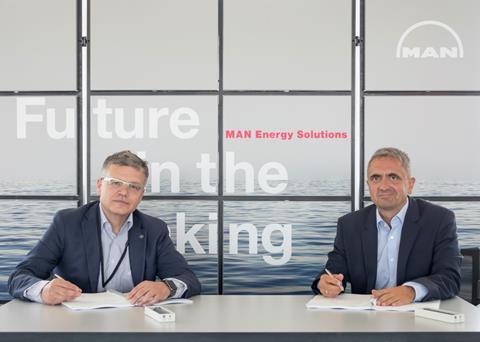
“The mtu brand is characterized above all by its in-depth know-how in high-speed applications. Thanks to this product expansion, we are now able to offer our customers exactly the right turbocharger for their high-, medium- and low-speed applications under one roof via the PBST brand,” says Dr. Uwe Lauber, CEO of MAN Energy Solutions.
The mtu turbochargers are offered on the basis of a modular system for engines in the 400 to 2,500 kilowatt power ranges in single- and two-stage versions. Apart from marine applications, Rolls-Royce designs them to meet the requirements of applications such as rail, construction, heavy land vehicles and power supply.
“With this cooperation, we are combining our competencies − on the one hand, PBST’s global sales structure for turbochargers and, on the other hand, Rolls-Royce’s latest high-efficiency mtu turbocharger technology for high-speed diesel and gas engines,” explains Andreas Schell, CEO of Rolls-Royce Power Systems.
“Advanced turbocharging helps engines achieve low fuel consumption and high power over a wide speed range. It is an important building block for meeting increasingly stringent emission requirements in the future - without compromising engine performance or efficiency,” explains Dr. Otto Preiss, Chief Technology Officer and COO of Rolls-Royce Power Systems.
“With the aim of offering new propulsion and energy solutions for a climate-neutral future, we are also currently working on electrically assisted turbochargers for greater agility and lower fuel consumption, as well as on turbocharger concepts for fuel cells,” Preiss concluded.