



A look back at Propulsion and Future Fuels
The Motorship’s Propulsion and Future Fuels conference returned to Hamburg in November at a moment when regulation, investment risk and fuel-choice anxiety continue to weigh heavily on the sector.
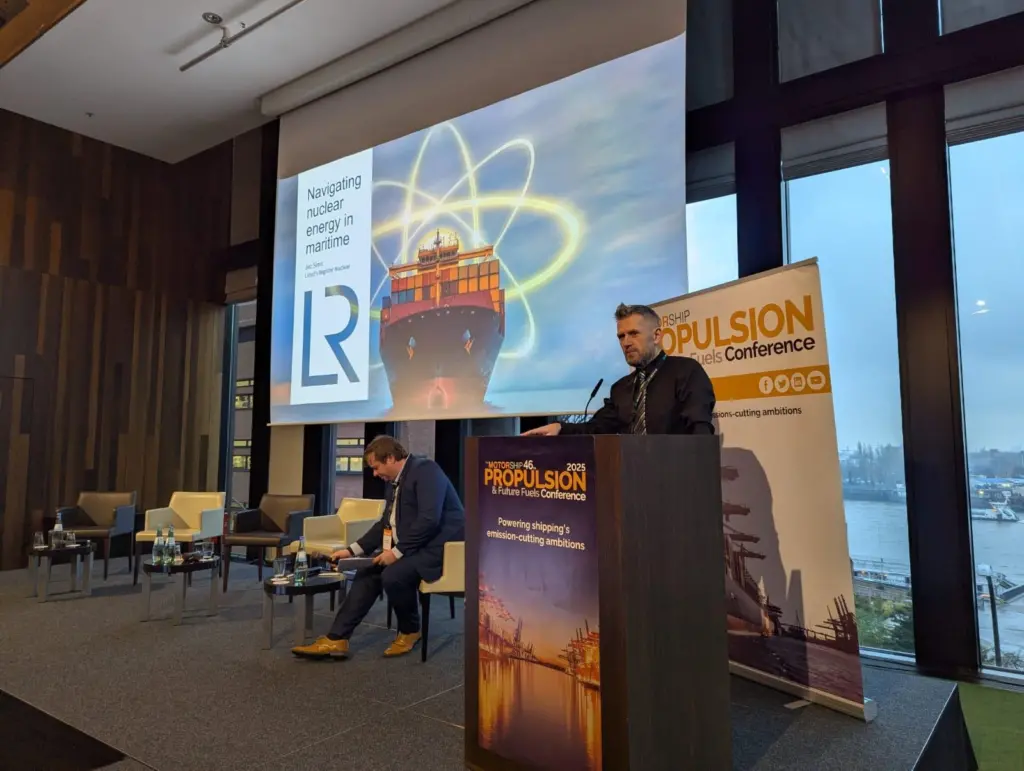
Yet this year felt markedly different from those held at other points of uncertainty. There was a renewed sense of consolidation with owners and suppliers increasingly anchoring their strategies to FuelEU Maritime, the EU ETS amid the IMO’s shifting plans but also a striking openness to options once regarded as peripheral.
Against the backdrop of intensifying regulatory uncertainty highlighted in The Motorship’s own reporting, the Hamburg discussions revealed an industry that is no longer paralysed by choice but instead prepared to explore a genuinely diverse, multi-fuel future. Within that landscape, areas not yet covered by our own series of special reports such as nuclear, wind propulsion and fuel cells came to the fore as technologies whose time for deeper examination has clearly arrived.
Nuclear
This month’s Special Report subject nuclear’s reappearance in the maritime conversation was not quiet. It was direct, technical and business-focused, framed by Jez Sims of Lloyd’s Register as an emerging reality rather than a distant prospect. His contribution reflected the industry’s new appetite for rigorously evaluating all options capable of meeting long-term climate obligations while retaining commercial viability. Sims described a suite of Generation IV reactor concepts—molten salt, lead-fast and high-temperature gas reactors—that are smaller, simpler and fundamentally safer than the legacy designs which have shaped public perception.
Their attraction lies in physics as much as engineering: nuclear fuel contains orders of magnitude more energy than conventional marine fuels, removing the tank-penalty and range compromises inherent in ammonia, hydrogen derivatives, methanol or biofuels. A ship operating for three to seven years between refuelling, with cargo capacity gains of around 10% from reduced tankage and machinery space, challenges many of the assumptions underpinning today’s decarbonisation pathways.
The Lloyd’s Register–Seaspan study of a 15,000 TEU container ship added commercial clarity, projecting operational benefits of roughly $68 million per year over a 25-year life through avoided fuel costs, fewer emissions constraints and higher service speeds. The barriers are no longer technological performance but regulatory suitability, supply-chain development and public confidence. Sims’ call for product-based licensing to replace the outdated site-specific paradigm was widely viewed as essential to enable scale. Engagement with ports, the IAEA and the Nuclear Energy Maritime Organisation to modernise entry requirements and certification frameworks reflects how seriously the question is now being treated. For an industry under pressure to reach net zero without sacrificing global service patterns, nuclear moved in Hamburg from thought experiment to serious contender for future deep-sea propulsion.
Wind propulsion
If nuclear presented the most dramatic shift in mood, wind propulsion offered a compelling example of a technology already delivering measurable, verifiable savings. Under the moderation of Gavin Allwright, a panel featuring BAR Technologies’ Lauren Eatwell and DNV’s Dr Uwe Hollenbach signalled how far the sector has come since early demonstrator trials. Eatwell traced BAR’s WindWings back to the simulation environment forged in Britain’s America’s Cup campaign, which has been repurposed to optimise merchant-ship rig configurations without reliance on towing tanks or wind tunnels. The Pyxis Ocean’s 2023 debut provided the first commercial proof point; the Newcastlemax Berge Olympus, equipped with four wings, has since set a new benchmark for sailing power in heavy-lift shipping.
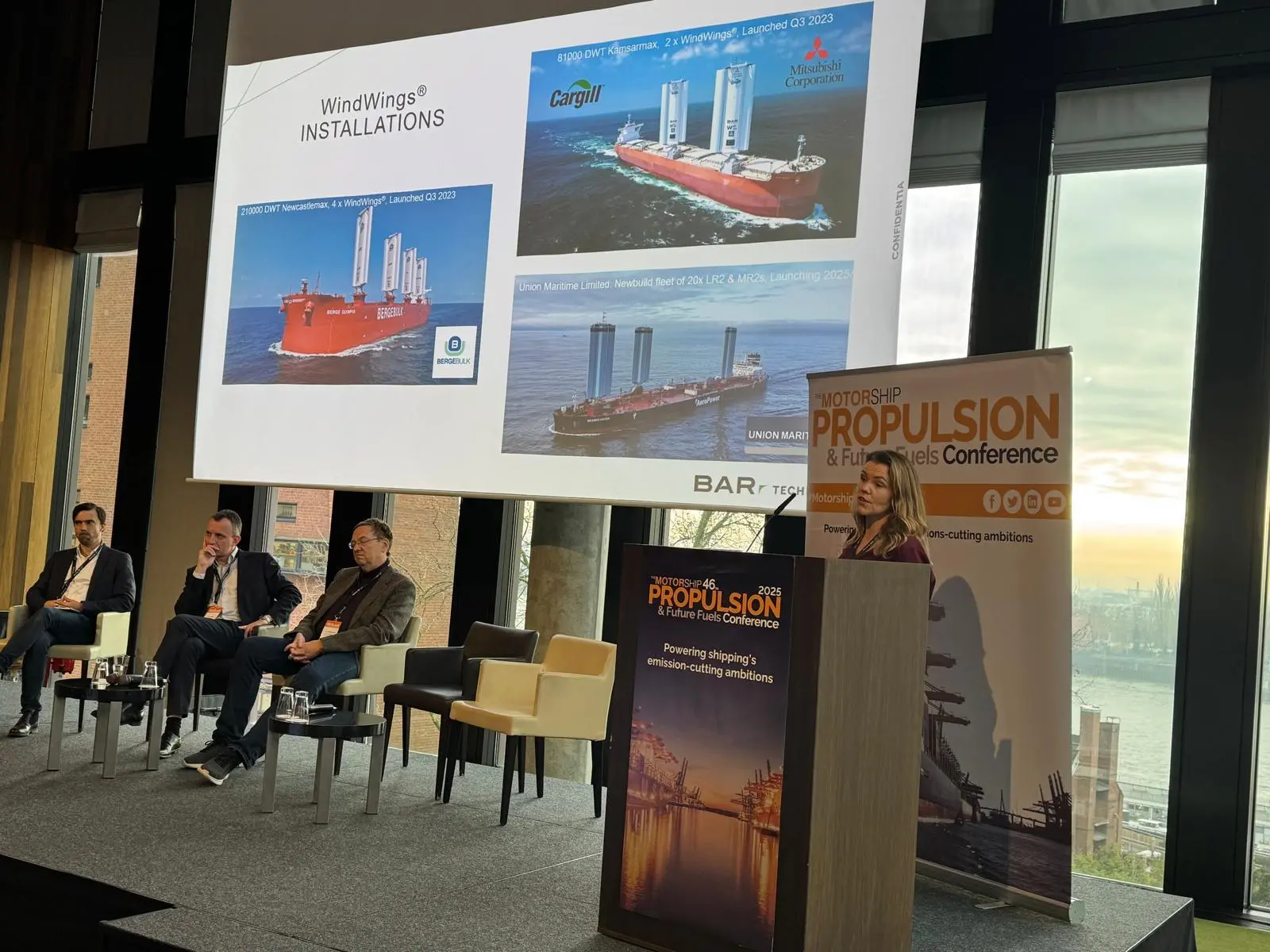
BAR is now scaling into full industrial production, supported by a partnership with China Merchants and a pipeline exceeding 20 wings for installation next year. Eatwell emphasised the critical role of deep simulation—velocity prediction, CFD, drivetrain modelling and long-term metocean analysis—in identifying the three-element design now deployed. Operational data, verified by DNV, shows that actual performance matches or exceeds projected gains, with early voyages recording up to 12 tonnes of saved fuel per day. Hollenbach emphasised that wind propulsion must fit a marketplace where owners prioritise different values: regulatory compliance, fuel-cost reduction or schedule resilience. He described the emergence of two design archetypes—small retrofits and fully integrated wind-dominant vessels—and stressed the importance of harmonised validation frameworks as long-term datasets accumulate. In a conference dominated by discussions of carbon intensity and compliance penalties, his reminder that fuel not burned is fuel not paid for resonated strongly.
Fuel cells
Fuel cells, another subject not yet covered in the Motorship’s special reports, were presented as technologies whose maturation is now undeniable. Lloyd’s Register’s Dr Thomas Bayer focused on safety and regulation, beginning with the challenges of hydrogen handling for PEM systems but clarifying that industry experience and updated rules are rapidly catching up. The IMO’s interim guidelines treat fuel cell modules as isolated black boxes, placing heavy emphasis on containment, ventilation and the avoidance of ignition sources. Bayer contrasted emergency-shutdown-dominated ESD-protected systems with gas-safe arrangements that contain leakage within a secondary enclosure, enabling unaffected modules to continue supplying power—a model increasingly favoured for its reliability and retrofit suitability. With installations above 6 MW now under development, fuel cells are stepping well beyond auxiliary roles.
ABB’s Sami Kanerva presented the operational perspective. He argued that while hydrogen remains central to the long-term vision, LNG, biofuels and natural-gas-based solutions will dominate the near-term landscape. Fuel cells will therefore proliferate in hybrid architectures: acting as range extenders for batteries; replacing or supplementing auxiliary engines, particularly in ports with limited shore power; or providing shore-side grid support. He highlighted the alignment between PEM systems and hydrogen or methanol reforming, and between solid oxide systems and LNG or potential future carbon capture. Fuel cells, in his assessment, will not overthrow combustion engines quickly but will become indispensable components in a staged, multi-fuel transition.
LNG
LNG and bio-LNG retained a central role in Hamburg’s discussions, reflecting their entrenched presence in the fleet and their continuing regulatory relevance. GTT’s Can Murtzaoglu presented the Mark III membrane system, the dominant containment technology in the LNG carrier sector and increasingly adopted for propulsion on container ships, bunkering vessels and cruise ships. He stressed LNG’s advantages over methanol and ammonia: higher energy density, established infrastructure, mature safety frameworks and regulatory compatibility extending through to 2037. Bio-LNG, he noted, provides an extended pathway to neutrality. The membrane system’s compatibility with methanol and ammonia offers owners hedging flexibility, and new cubic, chamfer-free tank geometries promise increased capacity and simplified shipyard integration. Advances in boil-off management, particularly through higher tank pressures and recondenser technologies, support near-zero methane slip for engines such as MEGI.
Henning Dicks of agriportance added a detailed view of Europe’s booming biomethane supply. Production now exceeds 70 TWh per year across more than 1,600 plants, approaching the scale of shipping’s projected LNG demand by 2030. The ability to use subsidised biomethane under FuelEU Maritime makes certain producing countries—especially Denmark and France—key suppliers. Dicks highlighted the economic and regulatory advantages of negative carbon-intensity bio-LNG produced from manure or waste, which can deliver substantial over-compliance benefits and strong financial incentives for LNG-fuelled vessels. Market data from 2024 shows price differentiation across carbon-intensity grades but sustained demand across all of them.
The familiar
Ammonia also remained in focus, with WinGD’s Dr Andreas Schmid and TGE Marine’s Andreas Humbucker providing a candid assessment of progress and limitations. Schmid detailed WinGD’s rapid development timeline, beginning from a point where almost no modern combustion data existed. Fundamental research, laboratory tools and process-engineering innovations—such as nitrogen-driven return systems and water-flush procedures—were necessary to make ammonia a viable fuel. The resulting two-stroke engine achieves diesel-like efficiency with over 90% tank-to-wake greenhouse gas reduction and minimal nitrous oxide formation. Orderbooks now span four engine sizes from 5 MW to 50 MW.
Humbucker addressed the ship-integration challenges: multi-compartment storage, incompressible-fluid circulation, leak detection, remote operation, and multi-stage ammonia emissions treatment to prevent any environmental release. The technology is progressing rapidly, but its success depends on rigorous risk management, training and regulatory alignment. Despite its toxicity and infrastructural immaturity, ammonia retains strong appeal due to its carbon-free combustion and potential renewable scalability.
Biofuels, meanwhile, remain essential but complex. Glander’s Mustafa El Zein emphasised that compliance under the EU ETS and FuelEU Maritime now hinges on careful data management, voyage planning and fuel procurement strategy. Matching feedstock, blend ratio, certification and port availability is far from straightforward, and many owners still underestimate the planning required. Carnival Maritime’s Stefan Fahrnholz echoed this view from an operator’s perspective. With 95 ships across eight brands, Carnival sees biofuels as part of a mosaic of solutions but not a dominant one. Variations in sustainability definitions, regional regulations, pricing and supply mean biofuels will contribute meaningfully but unevenly.
Across all sessions, the defining theme in Hamburg was neither rivalry nor uncertainty but realism. The sector is moving firmly into a multi-fuel future, where LNG and bio-LNG offer immediate solutions, wind propulsion and fuel cells broaden operational options, biofuels provide flexible compliance pathways, ammonia and methanol advance step by step, while nuclear re-enters the conversation with a seriousness few would have predicted a decade ago. In a year shaped by uncertain regulatory decisions and rising accountability, Propulsion and Future Fuels showed an industry ready not to narrow its choices but to explore them with renewed clarity and confidence.
Related Articles
 ALTERNATIVE FUELS & LUBRICANTS
 ALTERNATIVE FUELS & LUBRICANTS
 ALTERNATIVE FUELS & LUBRICANTS