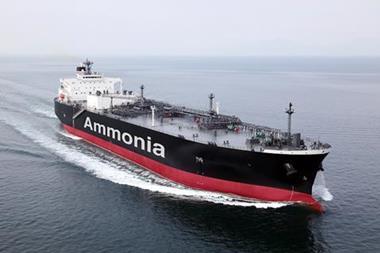
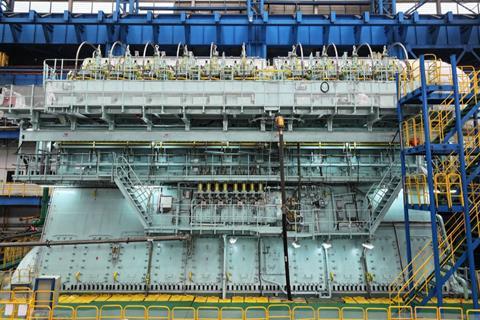


A EU-led project to bring forward the introduction of ammonia cracking technology connected with a PEM fuel cell into the marine industry has been awarded funding from the EU’s Horizon 2020 research and innovation fund. The project, which is focused on large deepsea vessels with an engine capacity of 1-10MW, is also intended to evaluate a novel ammonia engine capable of running on an ammonia/hydrogen blend of fuels.
The APOLO project aims to solve the challenges of power conversion from ammonia and develop an efficient and flexible ammonia cracking technology for the maritime sector.
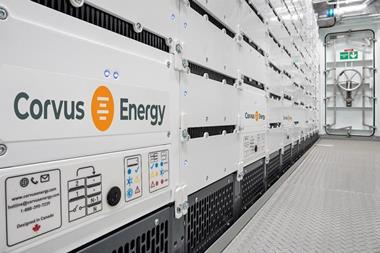
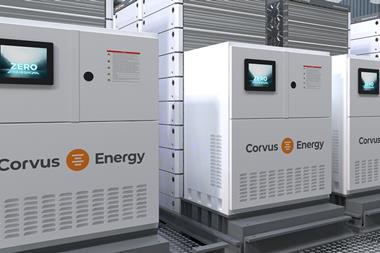
Corvus Energy is one of the participants in the project, which is being coordinated by Tecnalia. The participants are drawn from along the ammonia and hydrogen value chain, including H2SITE, Fertiberia and LEC Gmbh, as well as a number of research institutes and universities, such as TU Eindhoven and Chalmers University of Technology.
The 4-year program, which started on 1 January 2024, will demonstrate power conversion from commercially available fuel cell systems using hydrogen from ammonia cracking with a power output of 125kW. The program will also test an ammonia cracker coupled with a novel ammonia engine running on an ammonia/hydrogen blend to compare the different technologies.
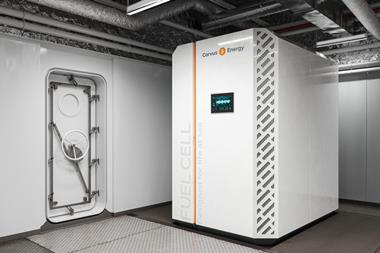
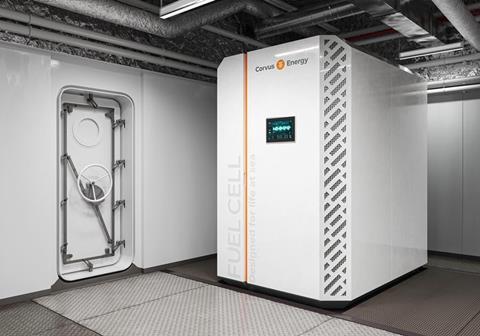
Through the program, Corvus Energy will work with H2SITE and the other partners on the development, integration, testing and demonstration of the ammonia cracker and their Corvus Pelican PEM Fuel Cell. In addition, Corvus Energy will lead a work package developing a business case for these systems used onboard ships.
The Motorship notes that project participant H2SITE, a hydrogen production technology company, is seeking to drive the development of hydrogen-based power generation systems for commercial marine applications. In our feature on ammonia cracking for maritime applications in October 2023, we noted that H2SITE says its cracking technology achieves high conversion efficiency due to its reaction and separation in a single stage, representing a substantial improvement compared to other transformation technologies. These systems have already been tested in pilot-scale terrestrial and maritime applications. Currently, they are being scaled up for larger applications.
“We are very grateful for the opportunity to collaborate on this exciting development. In decarbonizing the maritime sector, ammonia will be an essential part of the energy mix for ships sailing the longest routes and that also emits the most,” Svenn Kjetil Haveland, VP Development Projects explains and continues; “there are no commercially viable ammonia solutions available for the ship-owners as of today. Developing advanced methods for cracking ammonia and demonstrating scalability and overall system efficiency is an important step forward.”
The project funding is part of the Horizon Europe Framework Program, Horizon-CL5-2023-D5-01. The technologies developed in APOLO will be capable of targeting the first 30,000 ships in the market. Initially, the focus will be on vessels with 1 to 10 MW propulsion, with a significant number of them being around 3 MW in the next decade, as these are the first vessels relevant for ammonia-powered solutions.