


In his report on the accounts for the year ended 30 June, 2005, Lloyd?s Register Chairman David Moorhouse has announced that Group income rose by 1.4% to £371.8 million on the back of a strong performance by the organisation?s Marine business which grew revenues by 6%. The Group?s operating profit after charitable donations was £20.1 million. "Our underlying trading performance was markedly stronger than in the previous year as we continued to generate improvements in operating efficiency", Mr Moorhouse said.
The Group?s classed fleet increased by 7.4 million gross tonnes (mgt) to more than 120 mgt in 2005, the highest tonnage ever recorded to LR class in the organisation?s 245-year history. Lloyd?s Register?s share of the world fleet now stands at 18.3% in terms of gross tonnage.
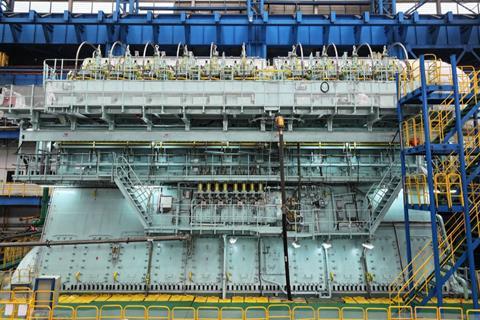
The year saw maritime industry technologies develop so quickly that the Group took the initiative to innovate new methodologies to class design concepts falling outside the boundaries of existing rules. Moorhouse commented: "A recent example of this was in Korea when we worked with Daewoo Shipbuilding and Wärtsilä to complete the safety case for the first dual-fuel electric propulsion system to be fitted in a large LNG tanker. Our approach evaluated the integrity of the installation to help minimise through-life risks to the crew, the environment, owners and operators."
The Management Systems business (which trades as ?LRQA? - Lloyd?s Register Quality Assurance) saw a small decline in revenue, after several years of growth. However, its client base grew by almost 100 every week. It now embraces every sector of activity, including food, engineering, service sectors and government departments. The main focus of the business is the delivery of quality systems services. However, there has been encouraging growth in systems for environmental, safety and security management. "The expansion of our environmental services reflects increased demand from organisations looking to demonstrate environmental improvement while delivering considerable financial savings", Moorhouse said.
The Energy & Transportation business saw mixed fortunes. The Oil & Gas sector saw broadly flat income year on year. In February 2005, BP?s Clair development project, the first fixed platform to be installed in the harsh West of Shetland environment, celebrated first oil. Employees from 20 Lloyd?s Register offices supported BP in the successful delivery of this prestigious and challenging project. As BP?s appointed independent verification body and integrity services supplier, Lloyd?s Register provided services at all stages, from detailed design through fabrication, installation and on to the operational phase.
Income from Industry services was also level with a year earlier. A key trend impacting the business is the migration of manufacturing away from Western Europe to lower cost producers in Asia. In particular, India, Korea, Malaysia, Thailand and the Philippines have become major manufacturers of pressure equipment and attractive markets for our services. In response, an Asia Region Industry business team with dedicated service delivery and sales managers has been set up.
Finally, Rail income declined by 8%. This was due to changes in the UK rail sector with work being taken back in house by the infrastructure operator. "Nevertheless, all our Energy & Transportation activities are an important part of our portfolio and we are very confident that they are going to contribute well in the future", concluded Moorhouse.