



The next generation of marine nuclear propulsion isn’t scaled-down submarine technology—it’s a portfolio of radically different reactor designs, most small, modular, and inherently safe. Three families are emerging as frontrunners, each offering distinct advantages for ships and floating energy platforms
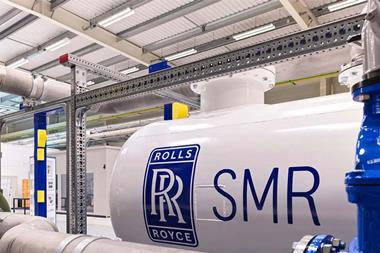
Integral pressurized light-water small modular reactors, such as NuScale Power’s VOYGR or Rolls-Royce’s 470 MWe design, house the entire primary circuit inside a single steel vessel immersed in a large water pool. Core, steam generators, and pressuriser are integrated into one factory-built module small enough to fit through the Panama Canal.
Operating at low pressure with gravity and natural convection for cooling, these systems eliminate the complex piping networks of earlier designs. For marine use, power is derated to 100–300 megawatts thermal, providing 30–100 megawatts electric to the shaft. Refuelling is expected to be every 10–15 years, and the entire reactor module can be swapped out in port like a massive cassette.
These reactors use High-Assay Low-Enriched Uranium (HALEU), enriched between 5 and 19.75 percent U-235. This allows much more compact cores than the 3–5 percent used in large commercial reactors. Vitally though, remaining far below weapons-grade material, making it one of the most commercially realistic fuels for early maritime deployment.
High-temperature gas-cooled reactors using TRISO fuel represent an even more robust approach. TRISO particles consist of tiny uranium oxycarbide kernels coated in multiple layers of carbon and silicon carbide—each kernel a miniature containment vessel. The fuel withstands temperatures above 1,600°C without releasing fission products, making meltdown physically impossible.
Ultra safe?
Ultra Safe Nuclear Corporation’s Micro Modular Reactor delivers 15–45 megawatts thermal from a helium-cooled core no larger than a shipping container. Because the fuel is so refractory, the reactor can be placed below the waterline with essentially zero risk of radioactive release even in the worst accident. USNC and Hyundai Engineering are already designing shipboard and barge-mounted versions.
Molten salt reactors represent the most revolutionary option. Instead of solid fuel rods cooled by high-pressure water, MSRs dissolve fissile material in liquid fluoride or chloride salt serving simultaneously as coolant and fuel. Operating at atmospheric pressure and 600–700°C, they’re walk-away safe. If power is lost or temperature rises too high, the liquid fuel drains into passively cooled tanks where it solidifies!
UK-based CORE POWER and Denmark’s Seaborg Technologies are developing maritime MSRs in the 200–800-megawatt thermal range. CORE POWER’s molten chloride fast reactor offers a transformative advantage: the liquid fuel enables periodic regeneration that can turn the fuel cycle into a net revenue source.
Every four to five years during routine dry-docking, the salt is removed and processed in a compact electrochemical facility. Fission products are separated, the salt is purified, and the remaining actinides, now enriched in valuable isotopes through breeding, are returned to the reactor with minimal fresh makeup.
The strong positive is that the recovered material, predominantly HALEU or bred plutonium and uranium-233, is cleaner and more valuable than the original feed due to higher fissile content and lower contaminants. In markets where HALEU trades at severe premiums, CORE POWER’s studies indicate regenerated fuel can be sold for substantially more than the combined cost of fresh fuel and reprocessing. For shipowners, the nuclear fuel line in the operating budget can become negative—the reactor literally pays for its own refuelling.
Thorium-based fuel cycles promise even greater advantages. Thorium-232 is three to four times more abundant than uranium and produces far less long-lived transuranic waste. When thorium absorbs a neutron, it decays through Pa-233 to produce uranium-233, one of the best fissile materials known. In well-designed reactors, more than one new U-233 atom is produced for every one that fissions, allowing the system to breed or approach break-even on fissile inventory.
The thorium cycle produces dramatically less long-lived waste. Most fission products decay to background levels within 300–500 years rather than tens of thousands required for conventional spent fuel. U-233 bred from thorium also carries inherent proliferation resistance, as the decay chain produces U-232, whose gamma-emitting daughters make the material extremely difficult to handle without heavy shielding.
Beyond propulsion, floating nuclear power platforms represent a paradigm shift for green fuel production. A single 800–1,200 megawatt thermal MSR barge can deliver constant high-temperature heat and electricity for water splitting, direct air capture of CO₂, and synthesis of carbon-neutral ammonia, methanol, or synthetic diesel. Seaborg has firm orders for twelve 200-megawatt compact molten salt reactor barges in Southeast Asia, while CORE POWER advances similar concepts with investment from Maersk.
These advanced reactors offer shipping a realistic path to genuine zero-carbon operation at lower lifetime cost than any alternative. The reactors are ready or nearly ready. The remaining question is whether shipowners, regulators, and society have the courage to embrace the atom once again.