



Commercial nuclear propulsion is no longer a pipedream. The combination of high-assay fuel availability, microreactor engineering, and closed-cycle fuel chemistry has produced a new generation of small modular reactors designed specifically for merchant hulls.
It’s not just about safety or endurance, but the technical architecture underpinning reactors that can run for a decade or more without refuelling, and in some cases return with fuel more valuable than the day it was loaded.
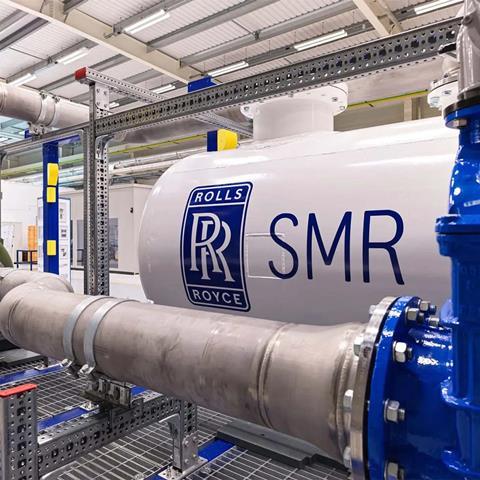
The dominant design for near-term deployment remains the integral pressurised water SMR (Small Modular Reactor), a machine re-engineered for commercial shipping. Unlike the looped plumbing of land-based reactors, the marine integral PWR houses its steam generators, coolant pumps, pressuriser and control systems inside one stout steel pressure vessel no more than 3.5 metres in diameter. By eliminating all external primary piping, it removes the spectre of a large-break loss-of-coolant accident entirely. The reactor operates around 15.5 MPa with coolant temperatures near 285–300°C, a deliberate reduction from land-based values to preserve thermal margins and cladding longevity in a compact, shock-tolerant geometry. The consequence is modest thermal efficiency—typically about 25%—but extraordinary reliability. With HALEU fuel, low power density and passive control, these reactors routinely achieve 10–15 year core lives without a single refuelling evolution.nuclear
The real breakthroughs, however, lie in the fuel. Conventional low-enriched uranium dioxide remains familiar, but the shift toward HALEU-based designs has unlocked long-burning cores impossible with 4.95% enrichment. Most marine programmes specify enrichments between 12% and 19.75% U-235, loaded into shortened fuel assemblies with 2-metre active lengths to accommodate hull geometry. Burnup targets of 60–75 GWd per tonne heavy metal are increasingly routine. The metallurgical precision embedded in these fuels is remarkable: ceramic kernels pressed and sintered to micrometre tolerances, housed in zirconium alloys engineered to survive decades of irradiation, thermal cycling and vessel motion without failure.
Beyond oxide fuels, the next tier of marine reactors relies on TRISO micro-encapsulated fuel—arguably the most robust nuclear fuel ever produced. Each kernel, the size of a poppy seed, is wrapped in a porous carbon buffer, inner and outer pyrolytic carbon layers, and a silicon carbide containment shell capable of maintaining integrity above 1,600°C. These particles are embedded in graphite pebbles or compacts and stacked into high-temperature gas-cooled core geometries. For a merchant vessel, the advantage is profound: the fuel cannot melt, cannot breach its coatings under any imaginable accident, and supports burnups exceeding 150 GWd/tHM with multi-decade sealed-core operation. When the core is spent, the entire vessel is lifted out as one sealed unit, eliminating at-sea handling altogether.
The most disruptive technology, however, is already emerging from the molten-salt community. Fluoride and chloride salt SMRs treat fuel not as pellets or particles but as a liquid mixture in which fissile isotopes are dissolved directly into the coolant. This collapses the classical boundary between fuel and working fluid. Operating at 650–700°C and near-atmospheric pressure, these reactors allow xenon stripping, online removal of neutron-poisoning lanthanides, and periodic electrochemical polishing of the salt inventory. A ship equipped with a 150–200 MWth fast chloride SMR might sail for five or six years before docking alongside a processing barge. In a 48-hour evolution the entire salt load is pumped out, lanthanides are removed by molten-salt/bismuth extraction, volatile products are distilled off, and the clean actinide-bearing salt is returned with a small top-up of fresh HALEU. Because fast-spectrum chloride systems breed fissile material at effective conversion ratios above unity, the returned salt is often richer in U-233 or Pu-239 than when first loaded. Fuel thus becomes an appreciating asset.
Whether solid or liquid, most SMR fuels are fully regenerable. Classical PUREX chemistry separates around 95% of uranium and nearly all plutonium from fission products using tributyl phosphate extraction. Reprocessed uranium can be re-enriched or blended into fresh cores; plutonium forms MOX fuels for thermal systems. Metallic and nitride fuels can be recycled through pyroprocessing in molten chloride electrolytes, producing mixed U-transuranic ingots ready for fast-system refabrication without ever isolating pure plutonium. These closed-cycle routes cut long-lived radiotoxicity by an order of magnitude and shrink waste volumes drastically. In every case the “spent” inventory returning from a marine SMR is not a disposal problem but a feedstock.
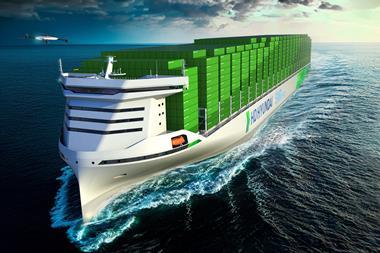
For shipping, the implications are extraordinary. A large container vessel equipped with a 200 MWth fast SMR may carry 10–15 tonnes of actinide salt worth tens of millions at today’s HALEU prices. After twenty or thirty years of operation and several reprocessing cycles, more than 90% of that material remains—and in many configurations is materially more valuable because of bred isotopes. In parallel, the reactor has emitted zero carbon, used no bunkers, and provided power originally equivalent to burning tens of thousands of tonnes of heavy fuel oil.
Marine nuclear propulsion is not simply a technical upgrade; it is a redefinition of what fuel means at sea. The engineering is proven, the fuels are recoverable, and the reactors are calibrated for commercial use rather than military secrecy. What remains is regulatory courage and industry appetite. On that foundation, the first wave of nuclear-powered merchant tonnage is no longer a futurist’s sketch—it is a near-term engineering reality built on reactor physics that finally matches the operational logic of global shipping.