



Nuclear Regulations Outdated
Regulation now sits at the centre of the maritime decarbonisation debate, shaping not only which fuels the industry may eventually adopt but also the pace at which any of them can move from pilot projects to commercial reality, including nuclear.
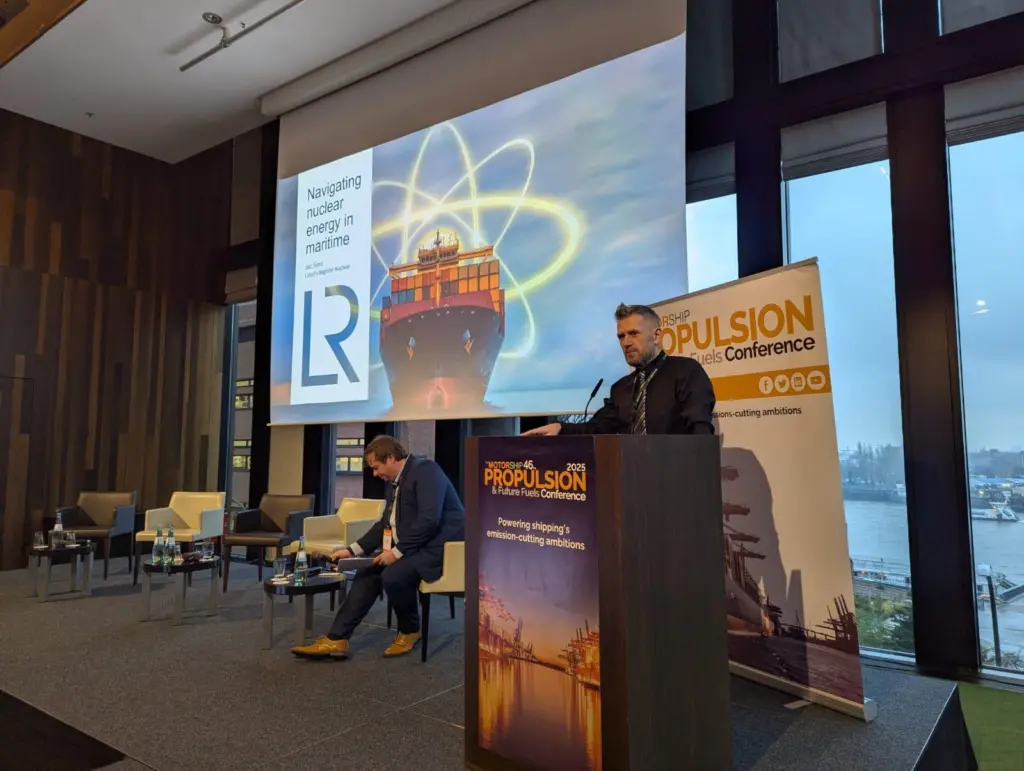
The current regulatory framework for maritime nuclear propulsion, rooted primarily in SOLAS Chapter 8 and the A491 Code, dates from the late 1970s and early 1980s. It was written for an era of large pressurised-water reactors and site-specific licensing, neither of which reflects the modular, inherently safe Generation IV reactors now under development. Updating these instruments is no longer a theoretical exercise: several member states have already submitted proposals to the IMO to begin modernisation, with more substantive discussions planned for early 2026. Parallel work between Lloyd’s Register and the IAEA under Project Atlas aims to establish an international pathway for certifying and licensing marine reactors.
This reform is not merely administrative. It determines whether reactors can be manufactured at scale. Sims advocates a move from site-based licensing to product-based licensing, in which a reactor design is licensed once, type approved and then produced repeatedly without relitigating every detail for each vessel. Lloyd’s Register has already applied this concept in work with Deployable Energy on a 2 MW electric microreactor intended as a replacement for diesel gensets, with the reactor licensed independently of its eventual installation. Such an approach could be central to commercial viability.
Port access and safeguarding pose further regulatory hurdles. Nuclear-powered ships will require harmonised international certification to ensure consistent acceptance at ports, along with updated procedures for emergency response, cyber-security, collision protection and fuel-handling oversight. Sims notes that collaboration is under way with ports and organisations including the Nuclear Energy Maritime Organisation to modernise outdated port guidelines. Without recognised certification and clear procedures, operational constraints could undermine the economics of nuclear propulsion, regardless of its technical promise.
Once the regulatory pathway is clarified, the technological argument for maritime nuclear propulsion becomes more tangible. Several Generation IV concepts are now under active consideration, including molten salt, lead-fast and high-temperature gas reactors. These designs rely on passive safety systems and accident-tolerant fuels, reducing the reliance on the active cooling systems implicated in historical nuclear incidents. Industrial interest is emerging, with companies such as Allseas announcing plans to design and build high-temperature gas reactors for marine use.
Nuclear attraction
The attraction lies in energy density. Nuclear fuel contains around 1.8 million times the energy of heavy fuel oil. Where fuels such as methanol or ammonia require large storage volumes and frequent bunkering, a nuclear-powered vessel could operate for three to seven years between refuelling, potentially longer with online refuelling systems. Eliminating frequent bunkering while increasing cargo space and offering carbon-free power fundamentally alters both operational planning and economics.
Safety remains central to regulatory and public acceptance. Sims emphasises that modern reactor designs incorporate passive shutdown mechanisms requiring no operator intervention or external power. He also notes that fast-spectrum reactors can use today’s spent nuclear fuel as feedstock, reframing waste management as a circular process. Collision protection and safeguarding, he argues, are engineering challenges well within the maritime sector’s existing competence.
A joint analysis by Lloyd’s Register and Seaspan offers a glimpse of what nuclear propulsion could deliver in commercial terms. By modelling a large container vessel over a full operating life, the researchers found that a nuclear-powered design could generate annual savings in the tens of millions of dollars, driven primarily by the near-elimination of fuel expenditure and the flexibility to sustain higher transit speeds without incurring emissions-related costs. The study also noted that dispensing with conventional fuel tanks and shrinking the machinery footprint would free up additional space on board, potentially boosting payload capacity by about ten per cent on an equivalent hull.
Sims concludes that nuclear propulsion is technically viable and could become a significant component of shipping’s future energy mix. For that to occur, three prerequisites must be met: successful demonstration projects to validate real-world operation, the scaling of industrial manufacturing and supply chains, and the harmonisation of international and national regulatory frameworks. Without these, the technology will remain confined to studies and prototypes.
Related Articles
 ALTERNATIVE FUELS & LUBRICANTS
 ALTERNATIVE FUELS & LUBRICANTS
 ALTERNATIVE FUELS & LUBRICANTS