

A three-year coating trial on board the 15,300 teu containership Maersk Hamburg has found significantly less corrosion and coating damage on a lashing bridge protected with Steelpaint’s moisture-cure polyurethane system than on an area coated with conventional epoxy.
The trial compared Steelpaint’s Stelpant system with a Hempel epoxy coating on Bay No.74, applied during scheduled drydocking at Qingdao Beihai Shipyard in China in March 2023. Both systems were exposed to identical operating conditions and mechanical damage from twistlocks and lashing rods.
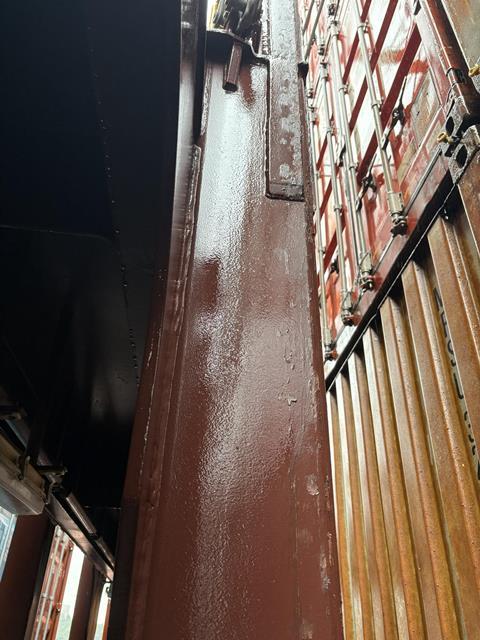
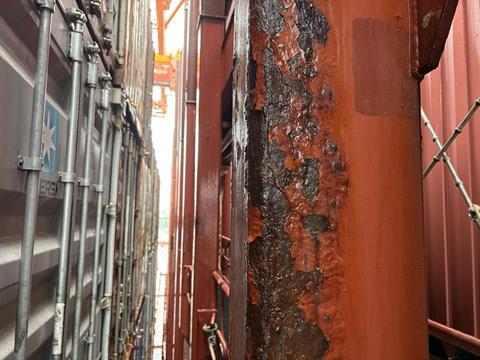
“After three years there is almost no corrosion but there was significant corrosion and impact damage on the lower part of the lashing bridge protected by the epoxy coating,” said Steelpaint director Frank Müller.
The Steelpaint system comprised a zinc-rich primer and polyurethane topcoat, with a total dry film thickness of 230µm. The Hempel system used a zinc-rich primer and epoxy mastic with a 250µm total thickness.
An inspection at Xiamen Port in July 2026 found corrosion on the Steelpaint-protected section had risen only from 0.1% after the first year to 0.3%. Corrosion on the Hempel-coated area increased from 5% to 15%.
Impact damage also increased more sharply on the epoxy system. First-coat damage rose from 10% to 30%, compared with an increase from 1% to 3% for Steelpaint. Second-coat damage reached 40% on the Hempel area, compared with 15% on Steelpaint.
The report also noted that the epoxy coating required regular crew maintenance, while the Steelpaint system required none during the three-year trial.
Müller said zinc remained attached to the steel even where the polyurethane system had been abraded, with little corrosion observed. By contrast, the epoxy system reportedly showed peeling, cracking and brittle behaviour following impact.
Steelpaint said the results could reduce maintenance costs and sea-store paint requirements over a potential ten-year service period. Müller also highlighted reduced VOC emissions and the system’s potential for wider use on board container vessels operating in corrosive, high-impact environments.