




Following its first full-scale installation on a seagoing vessel, the Vertom Tula, Wattlab is scaling its Solar Flatrack solution towards the international bulk shipping market.
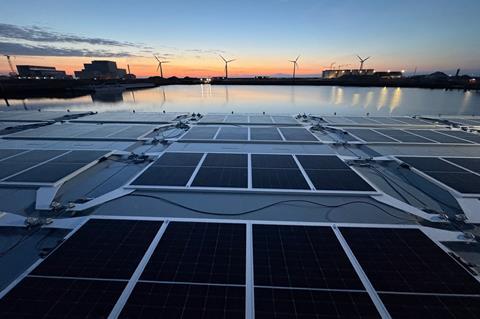
Currently, Solar Flatracks can be deployed on vessels up to and including the Supramax segment, but the idea is now to develop the solution for Panamax and even Capesize bulk carriers.
Bo Salet, CEO and co-founder of Wattlab, says solar energy can be a practical and scalable part of onboard energy supply - particularly for the vessel’s hotel load.
“For bulk carriers, and more broadly for vessels with large available deck space, solar power is a practical and economically viable way to reduce fuel consumption,” he tells The Motorship.
“This applies regardless of whether vessels run on conventional fossil fuels or alternative sustainable fuels. In all scenarios, solar contributes directly to reducing energy demand.”
The benefits of solar
After two pilot projects and a first full-scale installation on a coaster, results confirm that the Solar Flatrack system performs reliably at sea and directly contributes to fuel savings and emission reductions.
Mr Salet says that these savings depend on factors such as trading routes, vessel type, operational profile and whether the system is installed on a newbuild or retrofit. But as a general indication, solar can reduce fuel consumption by approximately 2 to 5%, which translates directly into CO₂ emissions reductions of a similar magnitude.
The system has been tested in collaboration with TNO and shipping company Vertom on the Vertom Anette vessel. The insights gained have subsequently been applied to the Vertom Tula, where 44 Solar Flatracks have demonstrated hotel load reductions of up to approximately 20%, depending on operating conditions.
Cutting-edge solution
Solar Flatrack is specifically designed for bulk carriers to be fully aligned with their operational requirements.
Mr Salet says the solution is best suited for vessels with large, unobstructed deck areas. For that reason, it is particularly relevant for bulk carriers, although it can be applied to other vessel types with similar characteristics.
A key concern for shipowners is the impact on day-to-day operations, particularly when carrying deck cargo.
The Solar Flatrack system has been designed to ensure that panels can remain in place during loading and unloading. The system can be easily disconnected and stacked if required and units can be compactly stored within the footprint of a single 20-foot container. As a result, the vessel’s operational flexibility remains fully intact.
“The system is low-profile enough to remain in place between hatch covers during cargo operations, while also being easy to remove when deck cargo is carried,” he adds.
“This level of operational integration is not achievable with conventional solar installations.”
With an expected return on investment of 3 to 5 years, Wattlab considers the system a financially viable solution for decarbonising both existing and new vessels.
Key advantages are reduced fuel consumption, lower exposure to volatile fuel prices, improved CII ratings and reduced costs under EU ETS and FuelEU Maritime.
In addition, Mr Salet points out that the system is relatively quick to install compared to other decarbonisation solutions.
Scaling up the system
Mr Salet says Wattlab is now focused on scaling up with the first commercial showcase projects of Solar Flatrack.
Currently, it’s preparing for the installation of the system onboard the BRF Froan for Berge Rederi. Once work is complete, the vessel will become the world’s largest battery-powered bulk carrier.
Mr Salet says market interest is growing rapidly. Wattlab has already engaged with more than 200 international parties interested in applying Solar Flatracks across their fleets.
Back in 2025, Wattlab partnered with HGK Shipping to equip the inland waterways vessel, Blue Marlin with its cutting-edge solar power system.
Featuring 192 solar panels, the vessel was the first of its kind to use solar energy for both onboard and propulsion systems.